Quackery in Orthotics and Prosthetics: Pakistan Can No Longer Look Away
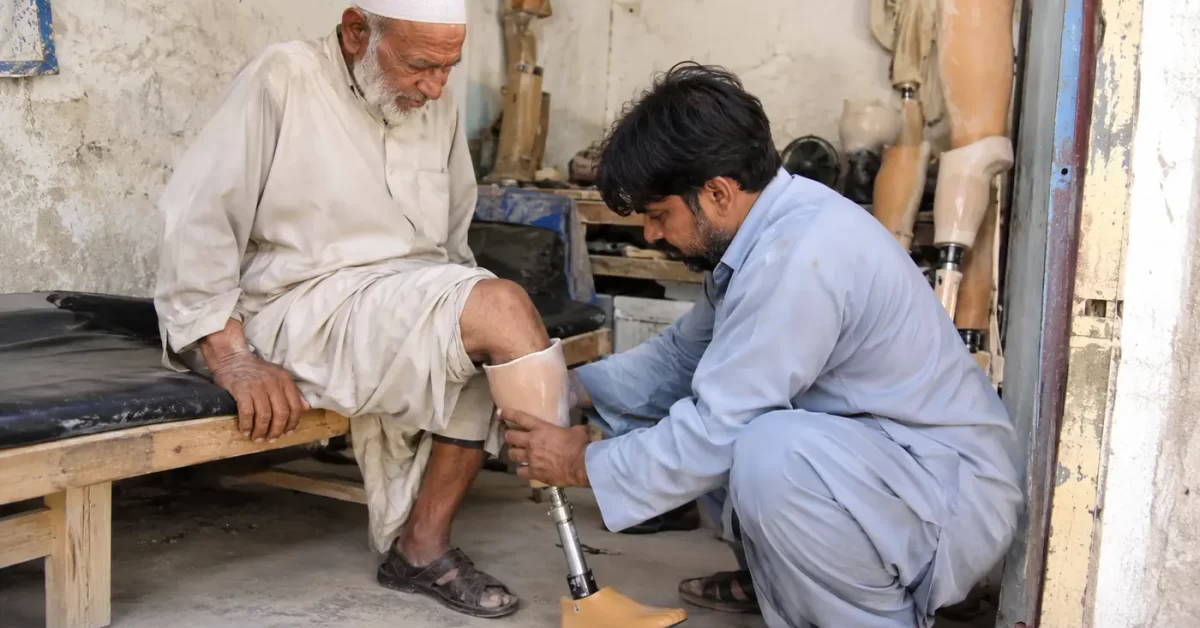

Ask any orthotist or prosthetist in Pakistan about the patients who arrive at their clinic for a second opinion, and the stories are strikingly similar. An amputee whose socket has rubbed his stump raw. A diabetic patient fitted with an ill-made insole that pressed a new wound into the foot it was meant to protect. A child with clubfoot whose correction slipped away because nobody explained that the brace must be worn as prescribed. A teenager with scoliosis wrapped in a rigid jacket that was never measured to her spine. Behind many of these cases is the same problem: the device was made, sold or fitted by someone with no professional training to do so.
This is quackery in orthotics and prosthetics, and it has been allowed to flourish in plain sight. It operates from roadside “artificial limb” workshops, from shops that sell braces and belts over the counter with no assessment, and increasingly from social media pages that promise “bionic” miracles at bargain prices. OPPAK warned about this two years ago. Little has changed on the ground.
The harm is not abstract. An artificial limb or a brace is not a shoe bought off a shelf. It transfers body weight through skin, muscle and bone, and it must be designed around a careful assessment of the person wearing it. A badly fitted device can cause pressure sores, infection, pain, falls and lasting deformity. For people with diabetes, a poorly made device can turn a manageable problem into a wound that threatens the limb. For a child, a wrong or neglected brace can undo months of careful treatment. And when a device hurts, many users simply stop wearing it, losing the mobility, independence and livelihood it was meant to restore.
Families do not choose quacks because they are careless. They choose them because they are cheaper, closer and easier to find, and because nobody has told them what a qualified orthotist or prosthetist is. The WHO–UNICEF Global Report on Assistive Technology (2022) found that more than 2.5 billion people worldwide need at least one assistive product, that nearly a billion are denied access, and that in some low- and middle-income countries access is as low as 3 per cent of need. Where professional services are scarce and most people pay out of their own pockets, unqualified providers fill the gap.
There is an irony here that should trouble policymakers. Pakistan led the first-ever UN General Assembly resolution on access to assistive technology, rightly earning international praise. Yet at home, people who need the most basic assistive devices are still left at the mercy of untrained hands.
The good news is that the tools to change this now exist. The Allied Health Professionals Council (AHPC), created under the AHPC Act 2022, has made registration mandatory for orthotists and prosthetists, with a deadline of 30 June 2026 set in its circular of 16 January 2026. The Council has also listed the institutes it recognises for degrees in orthotics and prosthetics. In April 2026, the Pakistan Medical and Dental Council issued a strict warning on scope of practice, showing that regulators are now prepared to act on who may do what. Pakistan also has four-year BS programmes, a growing body of qualified graduates and active professional associations. What it lacks is enforcement and public awareness.
The AHPC must lead. Registration is only meaningful if it is enforced. The Council should publish an open, searchable online register so that any patient, doctor or hospital can check, in seconds, whether a person fitting a limb or a brace is qualified. It should define a clear scope of practice for orthotists and prosthetists that says who may assess, prescribe, design and fit a device, and it should state plainly that unregistered practice is not acceptable. It must also follow through after the June deadline with inspections and penalties, working with the provincial healthcare commissions. The Punjab Healthcare Commission’s anti-quackery drives have shown that sustained action against unlicensed health outlets is possible; orthotic and prosthetic workshops should be part of that net, in every province. And as OPPAK has argued before, orthotists and prosthetists deserve a seat on the AHPC committees that shape the rules for their own profession.
The national associations cannot wait for the regulator alone. The National Association of Prosthetics and Orthotics (NAPO) Pakistan, which supported the first national conference dedicated to the field earlier this year, and ISPO Pakistan, the country’s chapter of the International Society for Prosthetics and Orthotics, should agree a common code of ethics and a national standard of care that their members commit to publicly. The WHO Standards for Prosthetics and Orthotics, developed with ISPO in 2017, already provide the framework, including clear expectations for a trained workforce. These bodies should run national awareness campaigns, give the public a simple way to report suspected quackery, and work with the AHPC to make continuing professional development a condition of staying registered.
The provincial associations are closest to the problem and should act like it. The Punjab Association of Prosthetists and Orthotists (PAPO) and the Sindh Association of Prosthetists and Orthotists (SAPO) are already running hands-on training and renewing their leadership. They are well placed to keep local directories of qualified practitioners, alert their provincial healthcare commissions to unlicensed workshops, train hospital administrators to employ only registered professionals, and take awareness into district hospitals, schools and diabetes clinics, where many future patients are first seen. Associations in other provinces should follow the same path.
Others share the responsibility. Hospitals, NGOs and government schemes that pay for artificial limbs and braces should buy services only from registered professionals and record who fitted every device. Doctors and physiotherapists should refer patients only to qualified orthotists and prosthetists. Universities should keep expanding seats and clinical training, and pathways such as the transitional BS programmes for experienced practitioners should be widened, so that skilled technicians who learned on the job can upgrade their qualifications rather than work outside the system.
Patients and families also have power. Before anyone measures you for a limb or a brace, ask for their qualification and their AHPC registration. A qualified professional will assess you properly, explain the device, check the fit and arrange follow-up. Be wary of anyone who promises instant results, sells a device without examining you, or offers a price that seems too good to be true. OPPAK’s guide to AHPC registration explains what a valid qualification looks like.
Quackery survives on silence, on the belief that “something is better than nothing”. For a person who has lost a limb or a child born with a deformity, a badly made device is not something. It is pain, lost time and lost trust. Pakistan now has the law, the degrees and the professionals to do better. The AHPC, NAPO Pakistan, ISPO Pakistan, PAPO and SAPO must now turn rules into practice, so that every artificial limb and every brace in this country is fitted by a qualified hand.
— The Editor, OPPAK
OPPAK is Pakistan's dedicated hub for orthotics and prosthetics since 2006— connecting students, professionals, patients and employers with credible news, education pathways, jobs, and success stories.
Leave a Reply