
Bone-Anchored Prosthetic Limbs: International Experts Agree on Key Components
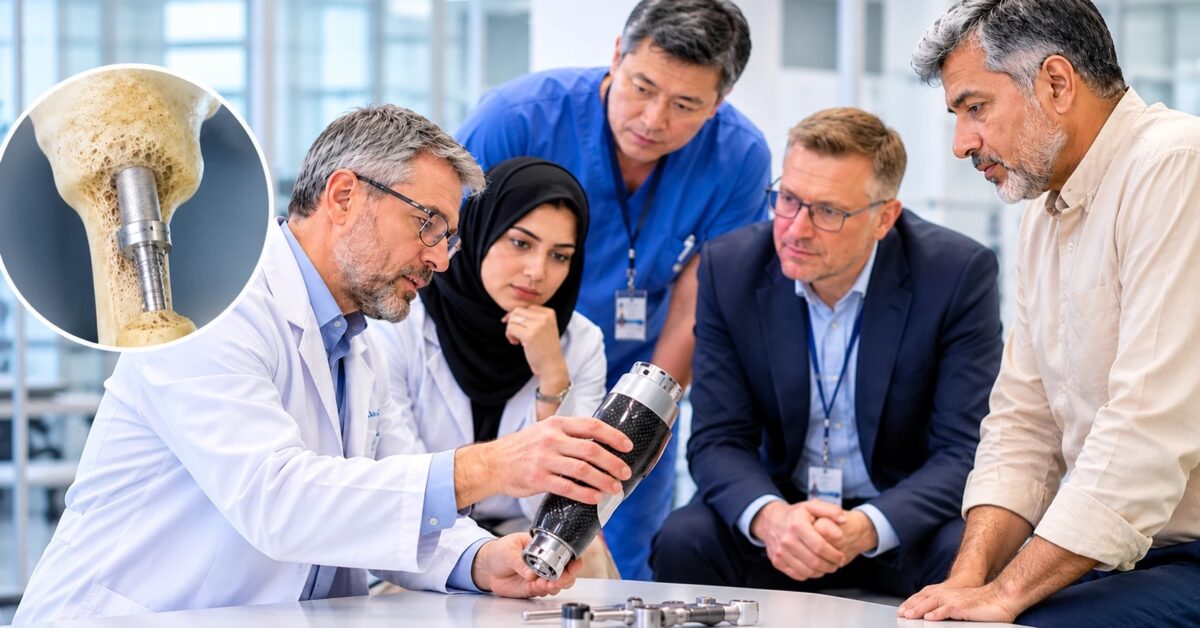

Experts from around the world have agreed on which parts should be used when building bone-anchored prosthetic limbs for people with a below-knee amputation. The recommendations come from an international consensus study led by researchers at the University of Colorado Anschutz Medical Campus (CU Anschutz), announced by the university on 2 November 2026.
The study, published in the Archives of Physical Medicine and Rehabilitation, says three components should be part of every below-knee (transtibial) bone-anchored limb: a safety connector, a torque absorber and a carbon-fibre foot. It is a small but important step for a field that its own researchers describe as still very young.
What is a bone-anchored limb?
Most people with an amputation wear a socket prosthesis: a hard shell, usually with a soft liner, that fits over the residual limb. In osseointegration, surgeons instead fix a metal implant inside the bone. A part called a percutaneous adapter comes out through the skin, and the artificial limb attaches directly to it.
According to the Hospital for Special Surgery (HSS) in New York, the implant is usually custom-made titanium, and the bone grows into it over about three months. HSS says the approach helps people who have not tolerated a socket, or who do not want one, and that it removes common socket problems such as a poor fit when the limb changes size. OPPAK explained the basics in an earlier feature, The Future of Prosthetics: How Osseointegration Works and Where It’s Headed.
The technique is not risk-free. HSS lists fracture, loosening and deep infection as reasons a patient may need revision surgery, and notes that long-term results are still limited because the procedure is relatively new. It has been performed in Sweden since 1990.
Why the experts needed to agree
Below the skin, a bone-anchored limb is very different from a socket. Above the skin, though, the rest of the prosthesis – pylon, ankle and foot – looks much the same. The problem, according to lead researcher Eric Earley, PhD, an assistant research professor of orthopaedics at the CU Anschutz School of Medicine, is that existing component recommendations assume a socket by default.
He told the CU Anschutz newsroom that much bone-anchored limb care is currently learned on the job, from experience or from other prosthetists, and that osseointegration is not a major part of standard prosthetic training. “Osseointegration is still in its nascency,” Earley said.
To fill the gap, the team used a Delphi method. In this process, a panel of experts answers several rounds of anonymous surveys, sees how the group responded, and can adjust its views. Earley said the anonymity helps to reduce “the bias of seniority” within the panel.
The three recommended components
- A safety connector. It sits outside the body and is designed to release under very high loads, like a ski binding. Earley explained that the setting must be just right: too low and the foot may come off unexpectedly, for example when stepping off a kerb; too high and excess force may pass into the implant and damage or fracture the bone. He added that most implant manufacturers already require this part.
- A torque absorber. It reduces twisting forces before they reach the bone, which the panel saw as a key way to protect the implant.
- A carbon-fibre (or fibreglass) foot with a split toe. These springy feet store energy when weight is placed on them and release it on push-off. Very simple feet, such as the SACH (solid ankle cushion heel) foot, were generally not recommended for these patients.
The panel also looked at powered, robotic and microprocessor-controlled ankles. These were typically not recommended, because of concern about adding extra forces to the implant, but the experts did not reach consensus against them either. Earley said dedicated studies are needed before prosthetists and manufacturers approve their use with bone-anchored limbs.
Not yet a clinical guideline
The researchers are clear that these are consensus recommendations, not evidence-based clinical guidelines. Earley said the next step is research to see whether the recommendations hold up “or need to be recalibrated” as more evidence appears, and only then can formal guidelines be proposed.
The CU Anschutz team also notes that care continues long after fitting. Work from its Bone-Anchored Limb Research Group shows some reversal of muscle wasting when patients walk with a bone-anchored limb, and muscle forces change over time. That means prosthetists may need to see these patients often to make small adjustments to alignment.
Why this matters for Pakistan
For most amputees in Pakistan, the socket prosthesis will remain the standard for years to come, and good socket fitting by a qualified, registered prosthetist is still the foundation of care. OPPAK has reported how even well-made conventional limbs can deliver strong results, for example in a study comparing laminated and moulded below-knee prostheses.
But advanced options are spreading worldwide. In September OPPAK covered the first U.S. patient to receive a bionic arm connected to bone, nerves and muscles. For local prosthetists and students, the new study is a useful reference: it shows that bone-anchored limbs need their own way of choosing components, with protecting the bone placed first.
The study is also a reminder that teaching must keep pace. As osseointegration spreads, prosthetists everywhere, including in Pakistan, will need specific training in safety connectors, torque control and follow-up – areas the researchers say are not yet a major part of most courses.
What readers should take away
Bone-anchored limbs are a promising but still-developing option, usually considered for people who have serious, ongoing problems with a socket. They involve surgery and carry real risks. Anyone curious about them should first discuss their situation with a qualified prosthetist and an orthopaedic or rehabilitation doctor. This article is general information, not medical advice. For more on recovery after limb loss, read OPPAK’s guide Life After Amputation: Understanding the Rehabilitation Journey.
Are you a prosthetist or student in Pakistan with experience or questions about osseointegration? Share this article with your colleagues and tell us your views in the comments.
Sources
- CU Anschutz Newsroom – New Research Collects Recommendations for Bone-Anchored Prosthetic Limbs (2 Nov 2026)
- Medical Xpress – New research collects recommendations for bone-anchored prosthetic limbs (3 Nov 2026)
- Earley EJ et al. Establishing Consensus for Prescription of Prosthetic Components for Transtibial Bone-Anchored Limbs: An International Delphi Method Study. Archives of Physical Medicine and Rehabilitation, 2026. DOI: 10.1016/j.apmr.2026.09.015
- Hospital for Special Surgery – Osseointegration Limb Replacement
OPPAK is Pakistan's dedicated hub for orthotics and prosthetics since 2006— connecting students, professionals, patients and employers with credible news, education pathways, jobs, and success stories.
Related in O&P International News

New Commonwealth Professional Fellowship Opens at Strathclyde’s National Centre for Prosthetics and Orthotics
ISPO Opens Applications for 2027 World Congress Participation Grants
Leave a Reply