
Ottobock Introduces 3D-Printed Silicone Liner for More Personalized Prosthetic Fit
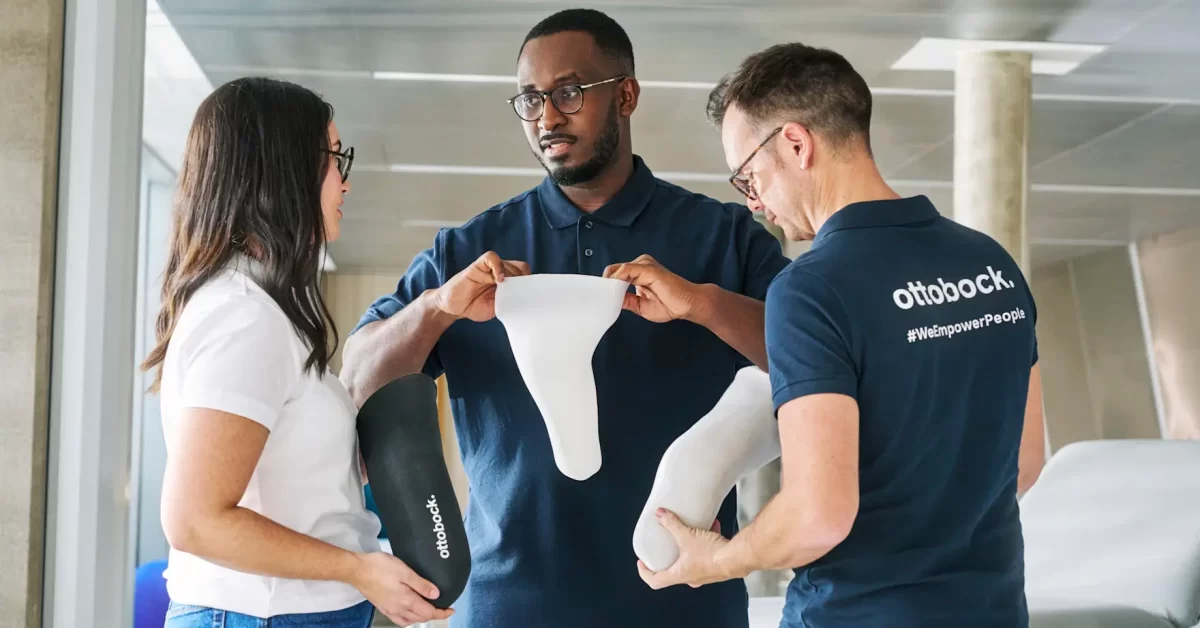

New additive-manufactured liner aims to bridge the gap between standard and fully custom prosthetic solutions
Ottobock has introduced iconiq, a 3D-printed silicone prosthetic liner designed to address one of the most common challenges in lower-limb prosthetics: achieving a comfortable and consistent fit.
The company launched the product in Germany during OTWorld 2026 in Leipzig, with a gradual international rollout now underway.
The liner is positioned between the user’s residual limb and the prosthetic socket and plays an important role in suspension, pressure distribution and overall comfort. According to Ottobock, its internal market research found that 68% of surveyed prosthesis users experienced fit-related problems.
From 3D scan to customized liner
Traditionally, prosthetists have had to choose between prefabricated liners, which offer limited customization, and fully custom-made solutions that can require additional time and fabrication steps.
iconiq uses additive manufacturing to offer a different approach.
The process begins with a standard 3D scan of the residual limb. The scan captures anatomical characteristics, including sensitive areas and scar tissue, without requiring markers or specialized scanning equipment.
The prosthetist then enters the residual-limb length and selects the appropriate design through Ottobock’s ordering platform. The digital information is transferred to the company’s production facility, where the liner is manufactured using 3D printing.
According to Ottobock, the process eliminates the need for traditional mould construction.
Designed for changing anatomy and activity
The liner incorporates different thickness profiles intended to provide more uniform compression and a secure interface between the residual limb and socket.
Ottobock says the design is intended for users with higher physical demands, including active and athletic prosthesis users, as well as both children and adults with a mobility grade of 2 or above.
For prosthetists, the technology represents a shift toward digital and scalable customization. Instead of treating customized liners as an exceptional solution, additive manufacturing could make individualized products more practical within routine prosthetic care.
What it could mean for prosthetic practice
The introduction of iconiq highlights a broader trend in prosthetics: using digital scanning, automated design and additive manufacturing to improve the connection between the residual limb and prosthesis.
A better-fitting liner can potentially contribute to improved comfort, suspension and pressure management. However, clinical assessment remains essential, as residual-limb condition, tissue tolerance, activity level and socket design all influence the success of a prosthetic interface.
As 3D printing becomes increasingly integrated into prosthetic fabrication, technologies such as iconiq could help prosthetists deliver more individualized solutions without the time and complexity traditionally associated with custom manufacturing.
Reference
This article was independently rewritten for OPPAK.com based on information published by Ottobock regarding the launch of its iconiq 3D-printed silicone liner.
Source: Ottobock, corporate.ottobock.com, June 1, 2026.
OPPAK is Pakistan's dedicated hub for orthotics and prosthetics since 2006— connecting students, professionals, patients and employers with credible news, education pathways, jobs, and success stories.
Related in 3D PRINTING
University of Melbourne Startup Develops Adjustable Lightweight 3D-printed Bionic Arm
Is 3D Printing the End of Traditional O&P?
Leave a Reply