Orthotics and Prosthetics Admission in Pakistan: FAQs for Students

Thinking about a career in orthotics and prosthetics (O&P) but not sure where to start? This guide answers the questions students in Pakistan ask most often about orthotics and prosthetics admission, from eligibility and entry tests to universities, scholarships and jobs after graduation.
Admission rules, fees and dates change every year and differ between universities. Always confirm the details on the official website or admission office of the university you apply to.
About the field
What is orthotics and prosthetics?
An orthotist designs and fits braces and supports (orthoses) for people with weakness, deformity or injury, such as children with clubfoot or adults after a stroke. A prosthetist designs and fits artificial limbs (prostheses) for people who have lost a limb. In Pakistan both are usually taught together, so graduates are trained in both areas. Read more in Why Orthotics Prosthetics?.
Is O&P a good career choice in Pakistan?
The need is large and growing. Road accidents, diabetes, congenital conditions, polio and conflict-related injuries mean many people need braces and artificial limbs, while the number of trained professionals is still small compared with that need. It suits students who enjoy science, working with their hands and helping people directly.
The degree
Which degree should I study?
The main route is a BS in Orthotics and Prosthetics (also called BS Prosthetics and Orthotics). It is a four-year, eight-semester professional degree, not a short certificate course. See Orthotics and Prosthetics as a Career: Understanding BS Programs in Pakistan for a full overview.
What will I study?
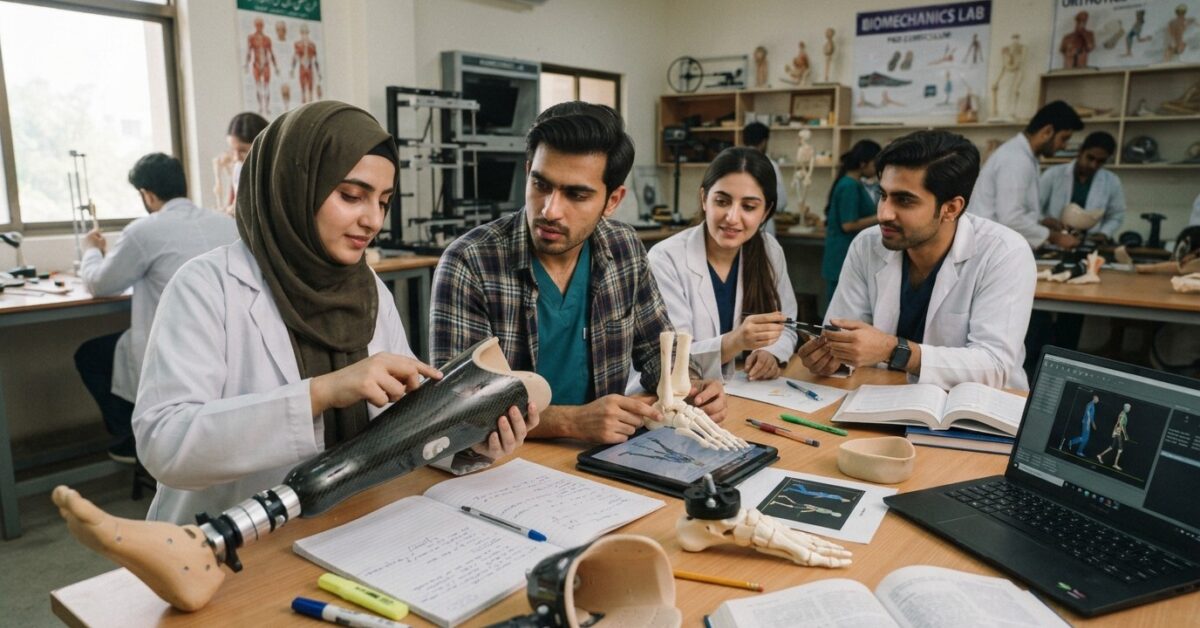
Expect a mix of medical science and practical workshop skills, including anatomy and physiology, biomechanics and gait, materials science, patient assessment, and the design, fabrication and fitting of orthoses and prostheses. Later semesters include supervised clinical work with real patients.
Curricula are reviewed from time to time; for example, UHS recently approved a revised Orthotics and Prosthetics curriculum.
Is there practical and clinical training?
Yes. Hands-on workshop and clinical training are a core part of the degree. Students practise casting, fabrication and fitting, and spend time in hospitals and rehabilitation centres. For an example, see how IPMR Peshawar’s P&O students train at the Paraplegic Centre.
Eligibility and admission
What qualification do I need to apply?
Most universities require FSc (Pre-Medical) or an equivalent qualification such as A-Levels with biology. Minimum marks vary by university and are usually set each admission cycle, so check the current advertisement. As one example, a recent scholarship for the four-year degree asked for at least 60% marks in FSc Pre-Medical.
Can I apply before my FSc result is announced?
Often, yes. Some universities let students who are awaiting their final result apply and sit the entry test, then submit the result before admission is confirmed. For example, KMU’s Centralised Admission Test (CAT) allowed this in 2026.
Is there an entry test?
Usually, yes. Khyber Medical University and its affiliated institutes use the KMU Centralised Admission Test (CAT), held several times a year at centres across the country. Other universities run their own entry test or admit on academic merit. Admission is normally merit-based, combining your marks with the test score.
How do I know a programme is properly recognised?
Check that the university is recognised by the Higher Education Commission (HEC) and that the programme appears on the Allied Health Professionals Council (AHPC) list of compliant institutes. We summarised that list in AHPC Lists Universities Offering Orthotics & Prosthetics Programs in Pakistan. Studying at a recognised institute matters for registration and jobs later.
Where to study
Which universities offer O&P in Pakistan?
The AHPC list of compliant institutes (August 2026) includes:
- Khawaja Fareed University of Engineering & IT (KFUEIT), Rahim Yar Khan
- Rawalpindi Medical University, Rawalpindi
- Government College University, Faisalabad
- Khyber Medical University, Peshawar, including affiliated institutes such as PIPOS in Hayatabad
- Isra University, Islamabad
Other institutes also offer the degree. Browse the full, province-wise directory of universities offering O&P degrees in Pakistan.
I already have a diploma or technician qualification. Can I upgrade to a BS?
Yes, some universities offer transitional (bridge) BS programmes for working professionals. For example, KMU Institute of Health Sciences, Islamabad, opened a Transitional BS Prosthetics and Orthotics programme for candidates with 15 years of education.
Fees and scholarships
Are scholarships available?
Yes. Most universities offer merit-based and need-based scholarships, and organisations sometimes fund O&P students directly. For example, fully funded P&O scholarships were offered to students from Balochistan under the Chamalang Education Initiative. Ask your university’s financial aid office what is available.
After graduation
Where can O&P graduates work?
- Government hospitals and rehabilitation centres
- Paraplegic and physical rehabilitation centres
- NGOs and humanitarian organisations working in rehabilitation
- Private orthotic and prosthetic clinics and workshops
- Companies that make or supply orthotic and prosthetic components
- Universities and institutes, as teachers and clinical supervisors
Do I need to register before I can practise?
Allied health professions in Pakistan are regulated by the Allied Health Professionals Council (AHPC). Check the AHPC’s current registration requirements when you graduate; studying at an AHPC-compliant institute makes this simpler.
Can I work or study abroad after a BS in O&P?
Many Pakistani graduates go on to postgraduate study or work overseas, usually after meeting that country’s registration and language requirements. See From Pakistan to the UK: A Career Roadmap for Orthotics & Prosthetics Graduates.
Can I study further after my BS?
Yes. Options include MSc programmes in prosthetics and orthotics in Pakistan and abroad, and supervised postgraduate clinical residency training, which some universities are now setting up with rehabilitation centres, such as the P&O residency agreed between Superior University and Ever Move Rehabilitation Center.
Still have a question?
Ask it in the comments below and the OPPAK team will try to answer, or follow OPPAK for admission announcements, entry-test dates and scholarship news as soon as they are published.
OPPAK is Pakistan's dedicated hub for orthotics and prosthetics since 2006— connecting students, professionals, patients and employers with credible news, education pathways, jobs, and success stories.
Leave a Reply