
From Pakistan to the UK: A Career Roadmap for Orthotics & Prosthetics Graduates
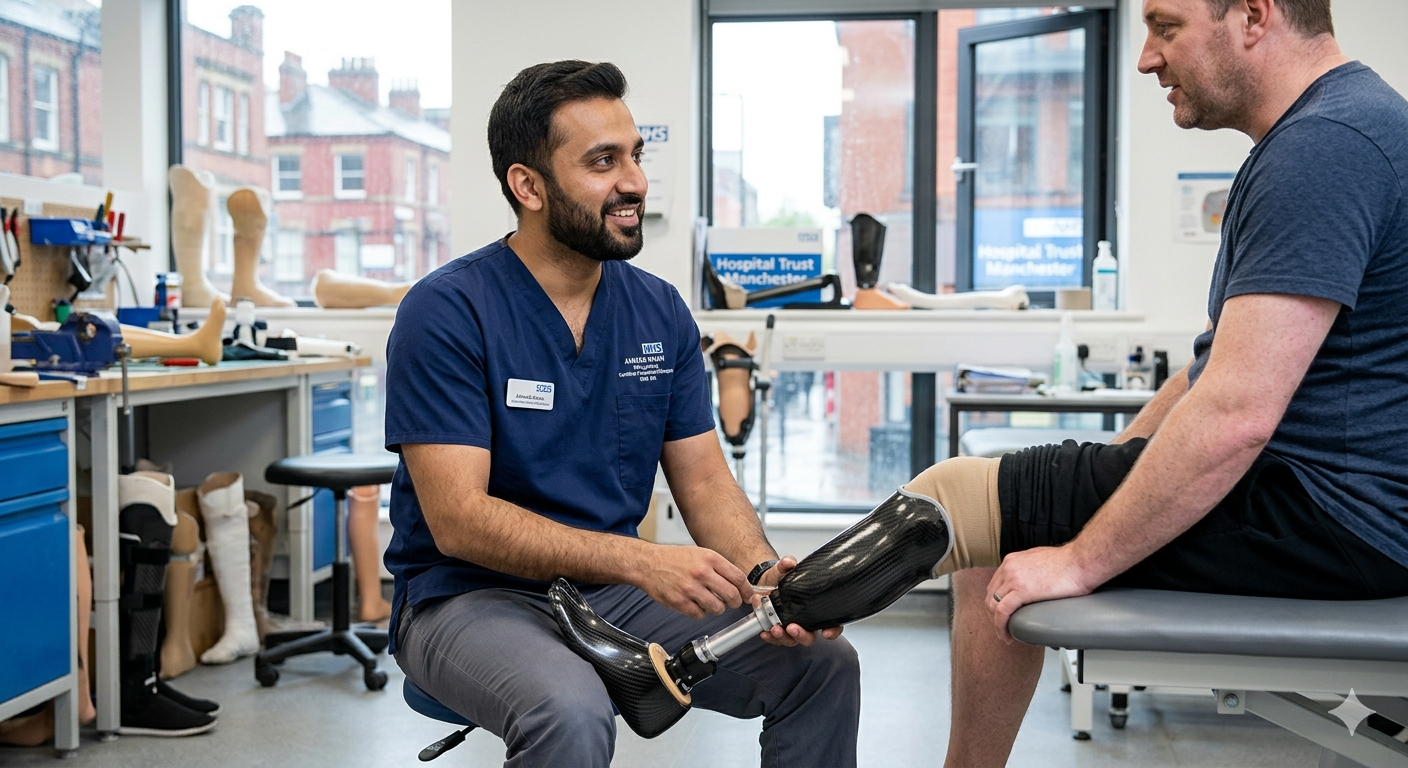

A practical, step-by-step guide for students and young professionals navigating registration, visas, job markets, and life in Britain
The United Kingdom’s National Health Service (NHS) faces a chronic shortage of allied health professionals, and orthotists and prosthetists rank among the most in-demand specialists. For Pakistani graduates holding a BSc or MSc in Orthotics & Prosthetics, the UK offers a structured, merit-based pathway to a well-paid and respected clinical career — provided you understand the system.
This guide walks you through every stage: from verifying your qualifications to landing your first NHS band, securing a visa, and building a long-term career in Britain.
Why the UK?
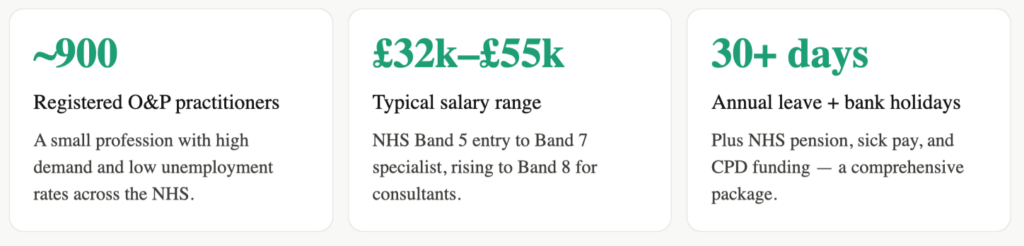
The UK is one of the few countries where orthotists and prosthetists are a fully regulated, degree-level healthcare profession with a defined career ladder, union protections, and pension entitlements. The NHS employs the vast majority of practitioners, with a growing private sector alongside it.
Step 1 — Understand HCPC registration
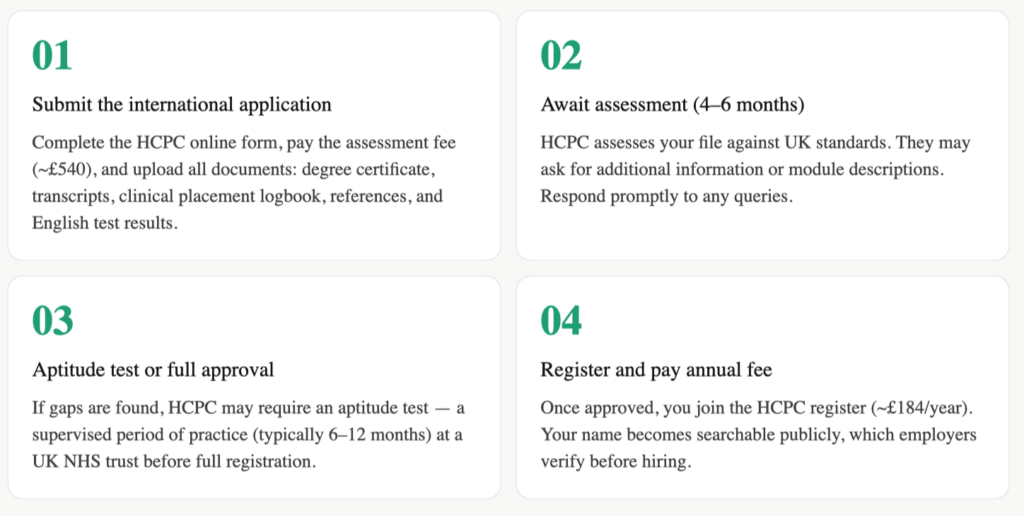
The Health and Care Professions Council (HCPC) is the statutory regulator for orthotists and prosthetists in the UK. You cannot legally practise without HCPC registration. As an internationally qualified applicant, you will apply through the international route.
The HCPC does not recognise specific countries or universities by default — every applicant is assessed individually based on how their training compares to UK standards.
What the HCPC assesses
- Your degree is at BSc level or equivalent in Orthotics, Prosthetics, or both
- Your clinical hours and placement training are comparable to UK programmes
- Your theoretical knowledge covers the HCPC’s standards of proficiency
- You have evidence of English language competence (IELTS or OET)
Typical Pakistani universities whose graduates apply
Graduates from the University of Health Sciences (UHS) Lahore, Liaquat University of Medical & Health Sciences (LUMHS), and Khyber Medical University (KMU) have all navigated this pathway. Success depends on the depth of your transcripts, clinical placement logs, and how well you document your training.
The application process
English language requirements
You must provide one of the following:
IELTS Academic — 7.0 overall, no band below 6.5 OET — Grade B in all sectionsDegree taught entirely in English (with HCPC approval)
If your degree was delivered in English at an accredited institution, HCPC may waive the test — but this is assessed case by case. Do not assume; confirm with HCPC directly.
Step 2 — Plan your visa route
Orthotics and Prosthetics has appeared on the UK’s Shortage Occupation List in previous years, which affects visa sponsorship costs. Your primary route will be the Skilled Worker visa.
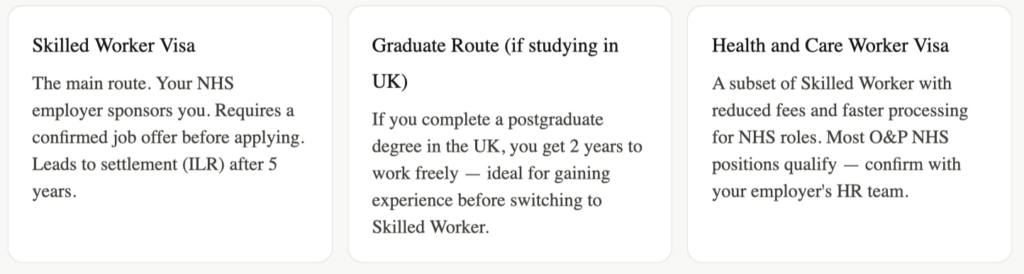
Many NHS trusts actively recruit internationally and hold sponsorship licences. They handle most of the visa paperwork — you just need your documents ready and HCPC registration confirmed (or an aptitude test placement arranged).
Step 3 — Find your first job
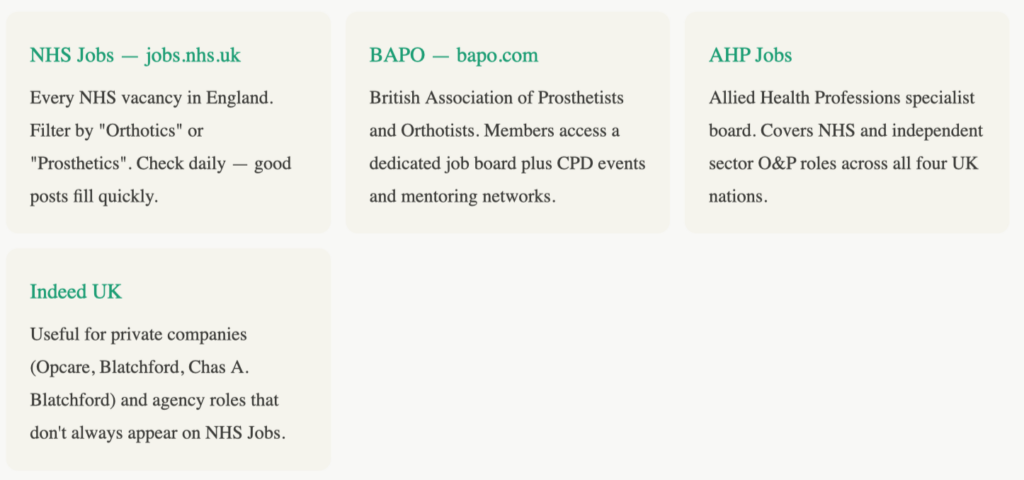
Almost all NHS jobs are advertised on a single national platform. Private sector roles appear on specialist job boards.
NHS pay bands explained
| BAND | ROLE LEVEL | SALARY (2024–25) | TYPICAL FOR |
|---|---|---|---|
| Band 5 | Newly qualified / entry | £29,970 – £36,483 | First UK post, newly HCPC registered |
| Band 6 | Clinical specialist | £37,338 – £44,962 | 2–5 years experience, specialist caseload |
| Band 7 | Advanced / senior | £46,148 – £52,809 | Complex rehab, team lead responsibilities |
| Band 8a | Consultant / manager | £53,755 – £60,504 | Service lead, research, education roles |
London weighting adds £5,000–£7,700 on top. Scotland, Wales, and Northern Ireland use similar but separate pay scales.
“The UK O&P workforce depends heavily on international practitioners. Your training from Pakistan, combined with HCPC registration, is a genuinely competitive asset — not a barrier to overcome.”
Step 4 — Prepare your application documents
Before you apply to any job or the HCPC, gather and certify the following. Start this process early — notarisation and attestation in Pakistan can take weeks.
- BSc/MSc degree certificate — attested by HEC and Ministry of Foreign Affairs
- Official academic transcripts — attested, with module descriptors if possible
- Clinical placement logbook — detailed hours, supervisors, case types
- Two professional references — from clinical supervisors or heads of department
- Valid passport — at least 6 months beyond your intended UK start date
- English language test results (IELTS/OET) — no older than 2 years
- Police character certificate (Disclosure and Barring Service equivalent)
- Proof of any AHP Council registration you hold
Step 5 — Build your career in the UK
The aptitude test period
If HCPC grants you a conditional approval with an aptitude test, treat it as an advantage, not a setback. You will work as a supervised clinician in an NHS trust for 6–12 months, gaining UK-specific clinical experience and building a local network — all while being paid. Many internationally qualified practitioners say this period dramatically accelerated their integration.
Continuing professional development (CPD)
HCPC requires you to maintain a CPD portfolio and renew your registration every two years. NHS employers typically provide CPD study leave and funding. BAPO runs annual conferences and clinical masterclasses — attend from your first year. Membership costs roughly £120/year and is widely considered essential.
Specialist areas with strong demand
Lower limb prosthetics Paediatric orthotics Spinal orthotics Diabetic foot care Neurological rehabilitationSports & upper limb prosthetics
Private sector opportunities
Companies including Opcare, Ability Matters, Blatchford, and Dorset Orthopaedic operate nationwide alongside the NHS. Private roles often pay slightly above NHS bands, with performance elements, but come without the NHS pension. After 2–3 years in the NHS, private practice becomes a strong option — and some practitioners do both via bank (agency) shifts.
Routes to senior roles and academia
The University of Salford and University of Strathclyde run the UK’s main O&P undergraduate programmes and hire clinical educators. With an MSc and several years of NHS experience, academic and research positions become accessible. Several Pakistani-origin clinicians now hold lecturing posts at these institutions.
Practical realities — life in the UK
Cost of living
London is expensive; consider starting in cities like Birmingham, Leeds, Manchester, Glasgow, or Cardiff where salaries are comparable but housing costs are significantly lower. NHS Band 5 salary is liveable in most of these cities, especially shared accommodation.
Community and support networks
The Pakistani diaspora is large and well-established in most major UK cities. BAPO has an active international members network. Online communities on LinkedIn and Facebook groups specifically for O&P professionals provide peer support, job tips, and mentoring from those who have made the same journey before you.
Recognition of your experience
Pakistan’s clinical burden — high rates of polio sequelae, trauma injuries, and diabetic complications — means Pakistani-trained O&P graduates often have unusually broad clinical exposure. Frame this explicitly in your personal statement and interviews. UK employers value diversity of clinical experience.
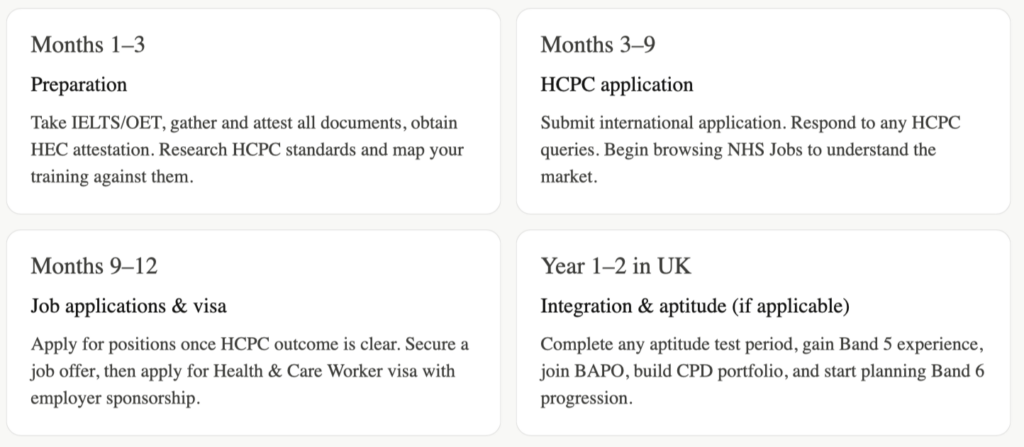
Timeline: a realistic roadmap
Key organisations and links
HCPC — hcpc-uk.org Your regulator. Start here. Read the international application guidance thoroughly.
BAPO — bapo.com. Professional body. Join as a student or associate member while still in Pakistan.
NHS Employers. Guidance on international recruitment, visa sponsorship, and induction frameworks.
UK Visas — gov.uk. Official Skilled Worker and Health & Care Worker visa guidance. Always use official sources.
This article is for guidance purposes. Always verify current HCPC fees, IELTS requirements, and visa rules on official websites, as policies change. Last updated April 2026.
OPPAK is Pakistan's dedicated hub for orthotics and prosthetics since 2006— connecting students, professionals, patients and employers with credible news, education pathways, jobs, and success stories.
Related in Career Guidance
Leave a Reply