
Laminated and molded Below-Knee Prosthetic Limbs Deliver Comparable Quality-of-Life Gains, Study Finds

RESOURCE : Journal of Health, Wellness and Community Research, Vol. 4 No. 7·Open Access Published 11/04/2026
A new peer-reviewed study from Pakistan finds that laminated and molded transtibial prostheses produce equivalent overall improvements in wellbeing after just six weeks — a clinically meaningful finding for healthcare systems navigating cost and access constraints.
For the millions of people living with lower-limb amputation worldwide, the choice of prosthetic device is one of the most consequential decisions in their rehabilitation journey — shaping not only how they move but how they feel, socialise, and perceive their own health. A study published this week in the Journal of Health, Wellness and Community Research now offers some of the most direct comparative evidence yet: when it comes to overall quality of life, both laminated and molded transtibial prostheses deliver significant and broadly equivalent benefits after a six-week rehabilitation programme.
Conducted at the Institute of Physical Medicine and Rehabilitation, Dow University of Health Sciences in Pakistan, the study enrolled 20 adult male patients who had undergone transtibial — commonly known as below-knee — amputation. Researchers split participants evenly between the two prosthesis types and assessed their quality of life using the SF-36 questionnaire, a widely validated tool measuring eight health domains, both before fitting and again at six weeks post-intervention.

The results were striking in their consistency. Across all eight SF-36 domains — including energy levels, emotional wellbeing, pain experience, general health perception, and capacity for social activities — both groups showed statistically significant improvement from baseline. This means that regardless of which prosthesis type a patient received, the act of being fitted and completing a structured rehabilitation programme produced meaningful, measurable gains in how patients experienced their daily lives.
Both laminated and molded prostheses were associated with significant improvement in quality of life after rehabilitation, with no statistically significant difference in overall post-intervention scores between groups.
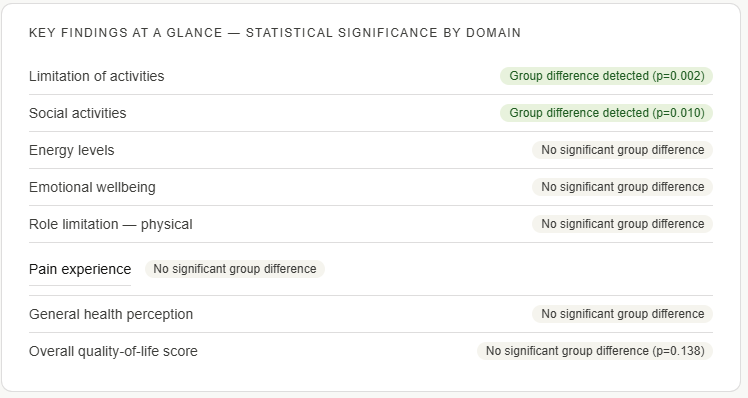
The total quality-of-life scores at the six-week mark were 92.30 (±8.72) for the laminated prosthesis group and 97.00 (±3.94) for the molded prosthesis group — a difference that did not reach statistical significance (p=0.138). In practical terms, this means the study could not detect a meaningful real-world advantage for either device when measured on the whole-person level.
Key findings at a glance — statistical significance by domain
Where Differences Did Emerge
The study did identify two areas where the groups diverged meaningfully. On the sub-scales measuring limitation of activities (p=0.002) and social activities (p=0.010), statistically significant between-group differences were observed — suggesting that the physical construction of a prosthesis may have subtler effects on specific functional dimensions even when the broader quality-of-life picture remains comparable.
The authors — Muhammad Abbas, Shahida Perveen, and Marium Anwar, all lecturers at the Sindh Institute of Physical Medicine and Rehabilitation — did not specify in the abstract which prosthesis type performed better on these individual subscales, underscoring the need to read the full paper for clinical granularity. Both researchers and clinicians are encouraged to access the full text, freely available under a Creative Commons licence, via the journal’s website.
Why This Matters
Transtibial amputation carries profound consequences that extend well beyond the physical: disrupted mobility, chronic pain, diminished social participation, and psychological distress are commonly reported outcomes. For healthcare systems — particularly in low- and middle-income countries, where both laminated and molded prostheses are in active clinical use — evidence comparing the real-world impact of device choice on patient wellbeing has been scarce.
Laminated prostheses are typically custom-fabricated through a labour-intensive process, layering composite materials to create a more rigid, individually contoured socket. Molded prostheses, by contrast, are generally faster and less expensive to produce, using thermoplastic materials shaped directly to the residual limb. The study’s finding that the two approaches yield broadly similar quality-of-life outcomes at six weeks could have significant implications for procurement decisions, clinical guidelines, and health economics in resource-constrained settings.
Limitations and Next Steps
The study’s authors used a pretest-posttest comparative design with convenience sampling, and the cohort was limited to 20 male patients aged between 20 and 60. The exclusively male sample and the short six-week follow-up window mean that results should be interpreted cautiously and may not generalise to women, older amputees, or longer-term outcomes. Larger, randomised, and longer-duration trials — ideally including diverse patient populations and functional performance measures alongside self-reported wellbeing — would be needed to confirm and extend these findings.
Nevertheless, the research contributes a valuable data point to an underserved literature. Both prosthesis types produced clinically meaningful improvements across every domain of the SF-36 within six weeks, reinforcing the central importance of access to prosthetic rehabilitation itself — regardless of which specific device is used.
Source: Muhammad Abbas, Shahida Perveen, Marium Anwar. “Comparative Evaluation of Quality of Life in Patients Using Laminated and Molded Transtibial Prostheses.” Journal of Health, Wellness and Community Research, Vol. 4, No. 7 (2026). DOI: 10.61919/9ehkxf52 | Published: 11 April 2026 | Open Access under CC BY 4.0 | Read the full paper →
OPPAK is Pakistan's dedicated hub for orthotics and prosthetics since 2006— connecting students, professionals, patients and employers with credible news, education pathways, jobs, and success stories.
Related in Featured

SAPO Announces Newly Elected Organizational Committee

Pakistani, Tajik Students Win Second Prize for 3D-Printed Foot Insoles and Back Braces in ‘Belt & Road’ Business Challenge


Leave a Reply