
Myoelectric Prostheses: How They Work and What to Expect
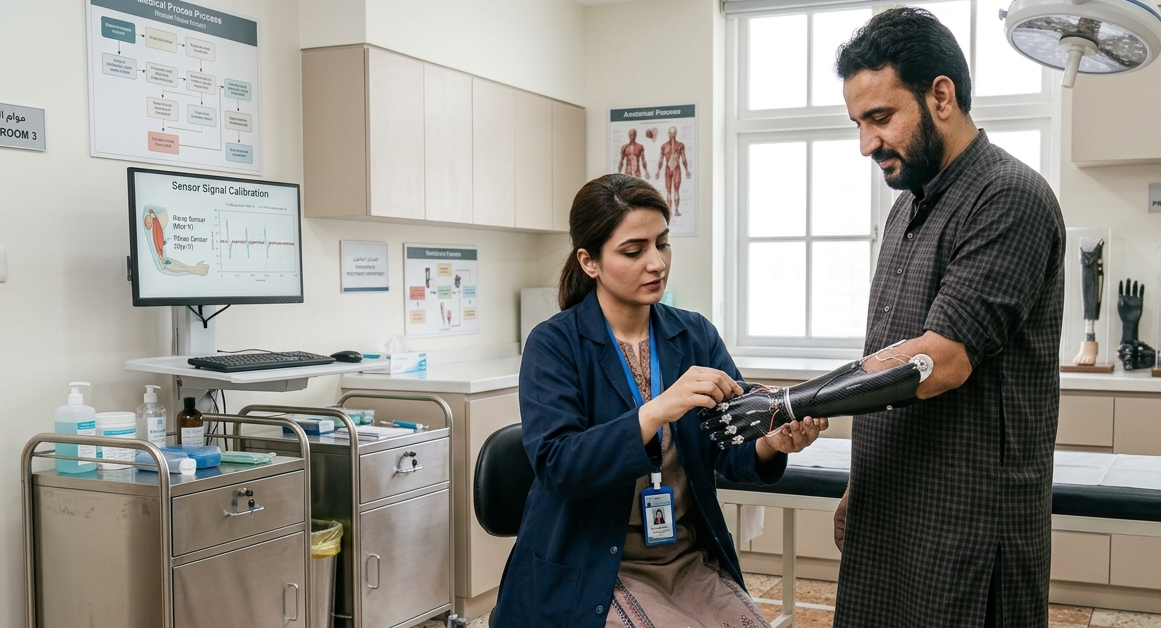

Losing a hand or part of an arm changes far more than appearance. It affects how a person dresses, eats, works, and relates to the world with their hands, which is something most of us rarely stop to think about until it is gone. Among the options available to restore function, the myoelectric prosthesis is one of the most sophisticated. For many patients it feels closest to the idea of a “bionic” limb they have seen in films, and that expectation is worth handling honestly from the very first consultation.
A myoelectric prosthesis is an externally powered artificial limb that is controlled by the electrical signals produced by the user’s own muscles. When a muscle contracts, it generates a small electrical potential. This is the basis of electromyography, or EMG. In a myoelectric limb, sensitive electrodes sit against the skin over selected muscles in the residual limb. They detect these tiny signals, an internal system amplifies and interprets them, and a small electric motor then opens or closes the hand, rotates the wrist, or bends the elbow depending on the design. In practical terms, the patient thinks about contracting a muscle much as they always did, and the prosthesis responds. There are no cables and no harness pulling across the shoulders, which is one of the features patients notice and appreciate first.
The essential parts
Every myoelectric limb is built around a few core elements working together. The socket is the foundation, and in my experience it matters more than any other single component. It is the custom interface between the residual limb and the device, and if the fit is poor, even the most advanced electronic hand will disappoint. The electrodes must maintain steady, reliable contact with the skin over the chosen muscle sites, so socket fit and electrode placement are deeply connected problems, not separate ones.
Beyond the socket sit the electronics, a rechargeable battery, one or more motors, and the terminal device, which is usually a powered hand but can be a specialized gripper. Higher-level fittings for people with above-elbow limb loss may add a powered elbow and a powered wrist rotator. The whole assembly draws power from the battery, which is why charging becomes part of daily life much as it is with a phone.
How the control actually works
The most common fitting worldwide is for people with limb loss below the elbow, the transradial level, because a good length of forearm muscle usually remains and provides clear, separable signals. A classic setup uses two electrode sites. One muscle group, often the forearm flexors, signals the hand to close, and the opposing group, the extensors, signals it to open. This is what clinicians call two-site, two-function control, and it is reliable and easy for most people to learn.
Modern systems add proportional control, meaning the strength of the muscle contraction determines how fast or how firmly the hand moves. A gentle contraction produces a slow, delicate closure suitable for holding a paper cup, while a stronger effort produces a faster, firmer grip. To switch between different functions, such as moving from grip control to wrist rotation, many systems use a quick co-contraction, where both muscle groups fire at once as a kind of mode switch.
For people who cannot generate two clean, independent signals, single-site systems exist, though they demand more careful control from the user. At the more advanced end, pattern recognition control uses several electrodes to read the overall pattern of muscle activity and, with the help of trained software, translates different patterns into different movements. This can feel more intuitive and can unlock more functions, but it depends on consistent signals and good training, and it is not the right answer for every patient.
Multi-articulating hands
Over the last couple of decades, powered hands have advanced considerably. Where earlier devices offered a single opening and closing motion between the thumb and two fingers, several manufacturers now produce hands with individually powered digits. These multi-articulating hands can form a range of grip patterns, a fine pinch for a key, a wide grasp for a bottle, a flat hand for carrying a tray, and users select between them through muscle signals, buttons, or a companion app. They look and move impressively, and for the right patient they are genuinely useful. They are also heavier, more expensive, and more demanding to maintain, and those trade-offs deserve a frank conversation before anyone commits to one.
Weighing myoelectric against body-powered options
It would be a mistake to present the myoelectric limb as simply the “better” choice. It sits alongside body-powered prostheses, which use a harness and cable driven by shoulder and trunk movement, and each approach has real strengths.
Myoelectric limbs offer a natural-looking hand, freedom from a restrictive harness, and often a stronger grip with less physical effort. Their weaknesses are weight, cost, sensitivity to moisture and dust, dependence on batteries, and the need for repair when electronics fail. Body-powered limbs are lighter, more rugged, more affordable, and give the user a subtle sense of feedback through cable tension, which is a genuine advantage in fine tasks. Their downsides are the visible harness, the physical effort of operation, and a more mechanical appearance. Many experienced users end up owning both and choosing between them depending on the task, using a durable body-powered limb for heavy or dirty work and a myoelectric one for social and precise activities. There is no single correct answer, only the right match for a particular person’s life and priorities.
Who is a suitable candidate
Assessment is where good prosthetic care is won or lost. A suitable candidate generally has a residual limb that has healed and settled, with adequate length and reasonable skin condition, and can produce muscle signals that the electrodes can reliably detect. Clinicians confirm this with muscle site testing before committing to a design, mapping where the strongest and most independent signals lie.
Just as important are the less technical factors. The person needs the cognitive ability to learn a new control strategy, the motivation to persist through training, and realistic expectations about what the device can and cannot do. Access to follow-up care, charging, and repair also has to be part of the picture, because a myoelectric limb is not a one-time fitting but an ongoing relationship between patient, prosthetist, and therapy team.
Training makes the difference
I cannot overstate how much rehabilitation determines the outcome. Handing someone a sophisticated device without proper training almost guarantees frustration, and frustration is the most common reason people abandon their prostheses. Training usually begins before the final limb is even built, with signal training that teaches the person to contract the right muscles cleanly and independently, sometimes using biofeedback so they can see their own signals on a screen. Once the limb is fitted, occupational therapy guides the person through graded tasks, from opening and closing on command to picking up objects of different sizes and finally to real activities like preparing food or fastening clothes. This process takes weeks and sometimes longer, and the patients who invest in it are the ones who go on to use their limb every day.
Honest limitations
A myoelectric prosthesis is a remarkable tool, but it is not a biological hand, and patients deserve to hear that plainly. Most systems provide little or no sensory feedback, so the user relies on their eyes to judge grip and cannot feel texture or temperature. The devices are heavier than many people expect. They dislike water and dust. Batteries run down, motors and electrodes need servicing, and the cost of the device and its upkeep is substantial, which is a real barrier in many settings. Setting these expectations early protects the patient from disappointment and protects the trust between them and their clinical team.
Where the field is heading
Research continues to close some of these gaps. Targeted muscle reinnervation, a surgical technique in which residual nerves are redirected to remaining muscles, can create additional and more intuitive control sites and has helped extend advanced control to people with higher levels of limb loss. Pattern recognition control keeps maturing. Work on sensory feedback aims to give users a sense of touch through stimulation, and bone-anchored fittings that attach the prosthesis directly to the skeleton are being combined with these ideas in research settings. Much of this is still developing rather than routine, but the direction is encouraging, and it means today’s honest limitations may soften over time.
For anyone considering a myoelectric prosthesis, the most useful step is a thorough evaluation with a qualified prosthetist who will assess the residual limb, discuss goals openly, and lay out the real trade-offs rather than promise a miracle. The technology is impressive, but the outcome always depends on the fit, the training, and the partnership between the patient and their care team.
OPPAK is Pakistan's dedicated hub for orthotics and prosthetics since 2006— connecting students, professionals, patients and employers with credible news, education pathways, jobs, and success stories.
Related in Myoelectric Prosthesis
Leave a Reply