
Spinal Orthotics: Bracing a Column That Must Also Move
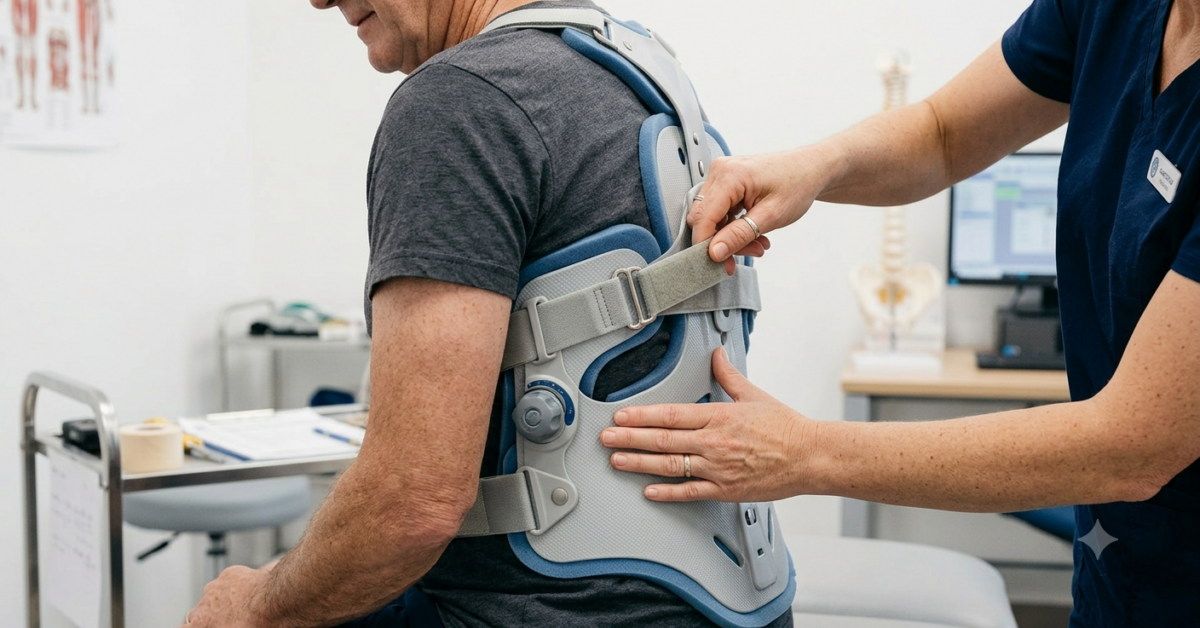

Ask most people what a back brace is for and they will tell you it holds the spine still. That is partly true, but it misses what makes the spine such a demanding structure to work with. The spine is not a single rigid pole. It is a stack of two dozen small bones, cushioned by discs and tied together by ligaments and muscle, and it is built to carry the weight of the head and trunk while still allowing you to bend to tie a shoe, turn to look over your shoulder, and expand your chest with every breath. Any device we place on it is therefore a compromise. Every degree of movement we take away in the name of support is a degree the person no longer has for daily life. Good spinal orthotic practice is the careful management of that trade off, giving up only as much motion as the medical situation genuinely requires, and no more.
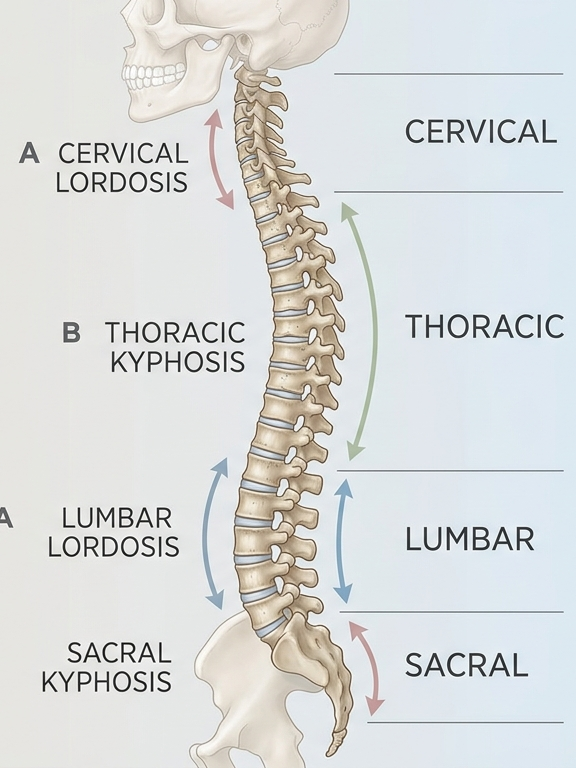
Spinal orthoses are usually described by the region they cover, and the names, though they sound like alphabet soup, are simply a map of the spine. A cervical orthosis works at the neck. A cervicothoracic orthosis extends from the neck down over the upper chest for more control. A thoracolumbosacral orthosis, the familiar TLSO, spans the chest, lower back and pelvis and is the workhorse of the field. A lumbosacral orthosis concentrates on the lower back and pelvis, and a sacroiliac belt sits lowest of all. What matters to the patient is not the acronym but the purpose, and in practice these devices are asked to do one of three quite different jobs.
The first job is to control movement so that injured or operated tissue can heal. After certain spinal fractures, or following spinal surgery, a surgeon may want the spine held in a safe position and protected from the loads of everyday bending and lifting while bone knits and soft tissue recovers. A well fitted TLSO acts as an external support that reminds the body of its limits and shares some of the load the healing spine would otherwise carry alone. A particular version worth mentioning is the hyperextension brace used for stable compression fractures at the front of the vertebrae, common in older adults with fragile, osteoporotic bone. By gently preventing the person from stooping forward, it keeps load off the already weakened front of the vertebra and allows healing with less pain and deformity.
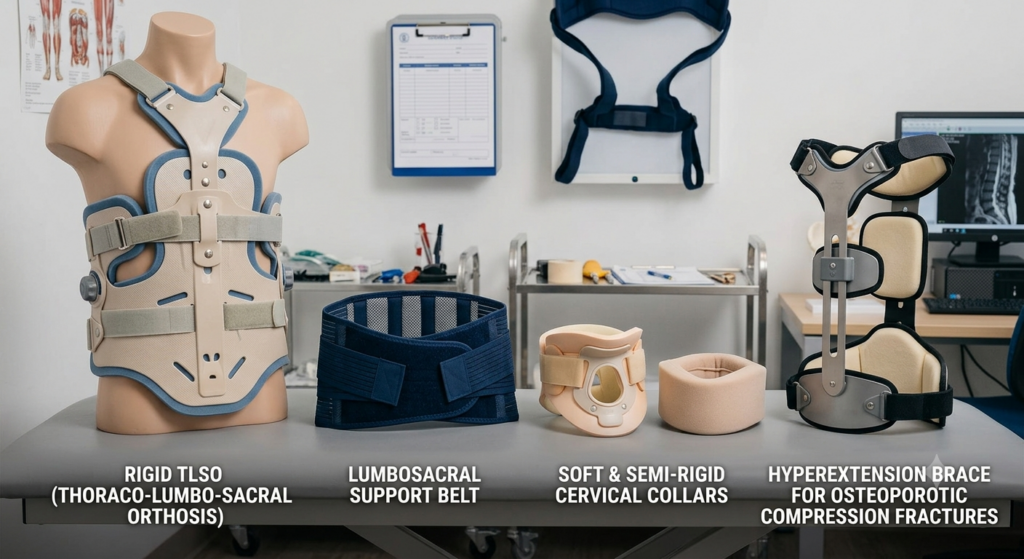
The second job is comfort and offloading in longstanding conditions. Here the evidence asks us to be honest with patients. For ordinary, non specific low back pain, a lumbar support is not a cure and should never replace the things that genuinely help, which are staying active, building strength, and addressing the habits that provoke the pain. A support can take some load off irritated structures during a flare or a demanding task, and many patients find it useful as a short term aid and a reminder to move carefully. What it should not become is a crutch worn every waking hour, because a spine that is never asked to support itself gradually forgets how, and the muscles that protect it weaken. I tell patients to think of these supports as a tool for specific moments rather than a permanent garment.
The third job is the one where orthotic treatment can change the course of a life, and it deserves the most careful explanation.
Bracing for scoliosis
Scoliosis is a three dimensional curvature and rotation of the spine. In adolescents it most often appears without a known cause, which is why it is called adolescent idiopathic scoliosis, and it tends to progress fastest during the growth spurt. The concern is not usually the curve a teenager has today but the larger curve it may become by the time growth finishes, because once a curve passes a certain size it stops responding to bracing and, if it continues, may eventually reach the point where spinal fusion surgery is considered. That surgical threshold is commonly around a Cobb angle of fifty degrees, and fusion, while effective, permanently removes motion from the segments it joins. The whole purpose of a scoliosis brace is to hold the line during the remaining growth so that the child reaches maturity below that threshold and, ideally, never needs the operation. clinicaltrials
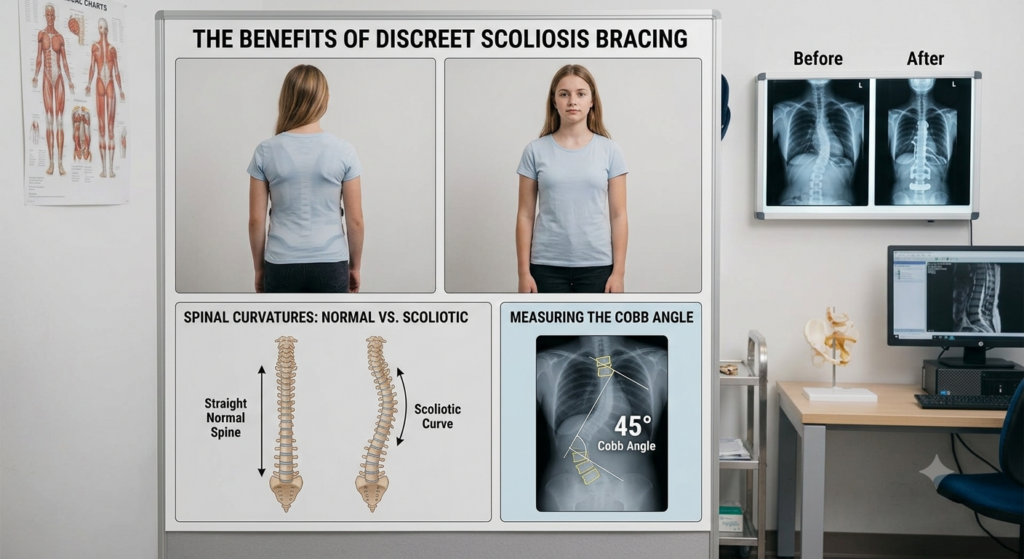
For many years this claim rested more on tradition than on solid proof, and families were right to ask whether bracing truly worked. That question was answered clearly by a large trial known as BrAIST. It studied previously untreated adolescents between ten and fifteen years of age, with curves between twenty and forty degrees and skeletal signs of remaining growth, and compared a rigid thoracolumbosacral brace worn for at least eighteen hours a day against simple observation. The result was decisive: bracing significantly reduced the chance that a high risk curve would progress to the surgical threshold, and the benefit grew with the number of hours the brace was actually worn. The benefit was large enough that, in the randomised part of the trial, only about four children needed to be braced to prevent one of them from reaching the point of surgery. MDedge + 3
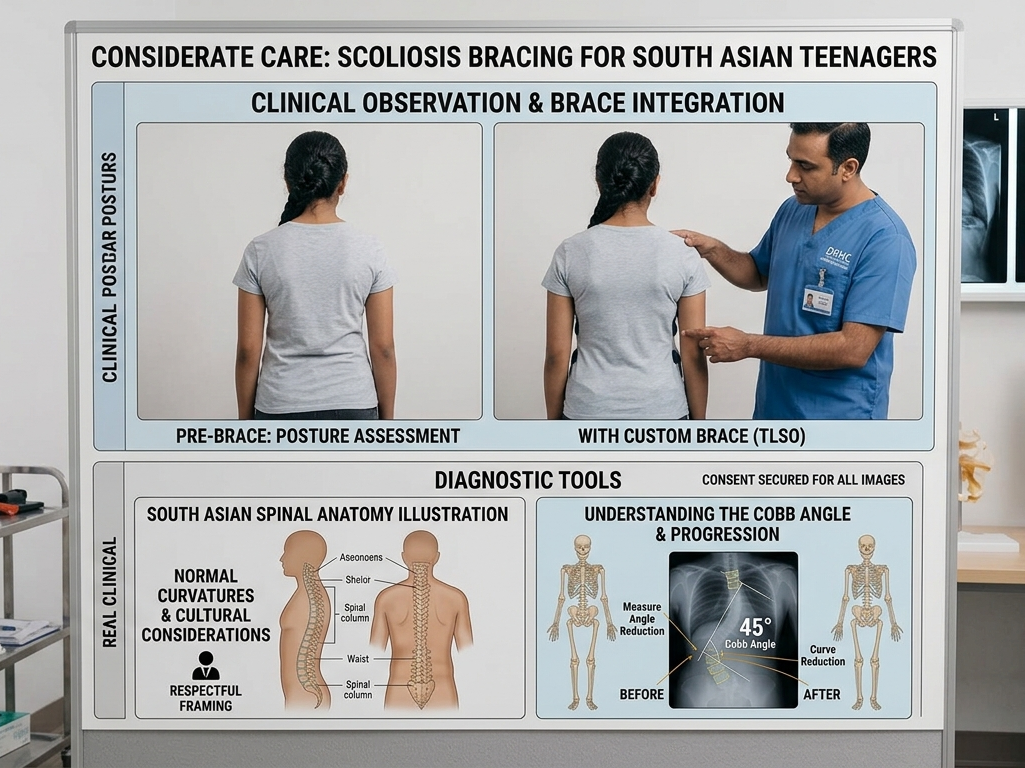
Two lessons from that trial shape how I counsel families every week. The first is that this is a genuine, evidence based treatment and not a hopeful tradition. The second, and the harder one, is that the brace only works if it is worn. Wear time follows a dose response relationship, and consistent use in the region of eighteen hours a day is strongly associated with avoiding surgery, while a brace left in the wardrobe does nothing at all. This is why so much of our effort goes not into the plastic and straps but into the young person wearing them. A scoliosis brace arrives at one of the most self conscious times in anyone’s life, and a device that is uncomfortable, obvious under clothing, or never explained will simply not be worn, however well it is designed. Fit, comfort, honest conversation and ongoing encouragement are not soft extras here. They are the treatment. SpringerScoliosisPTJax
That, in the end, is the theme that runs through all of spinal orthotics. The brace is only ever half the work. A device is designed, cast or scanned, fitted and adjusted, but its success is decided by whether it earns a place in a real person’s day, by whether the skin under it stays healthy, by whether the wearer understands what it is for and how long they will need it, and by whether we have been truthful about what it can and cannot achieve. A spinal orthosis cannot make a spine young again or substitute for the strength that comes from movement. What it can do, used for the right reason and worn as intended, is protect a healing spine, ease a difficult season, or quietly steer a growing one away from the operating theatre. Those are considerable gifts, and they are worth getting right.
OPPAK is Pakistan's dedicated hub for orthotics and prosthetics since 2006— connecting students, professionals, patients and employers with credible news, education pathways, jobs, and success stories.
Leave a Reply