Now Reading: Can 3D-Printed Orthotic Insoles shape the Future of Personalized Foot Care ?
-
01
Can 3D-Printed Orthotic Insoles shape the Future of Personalized Foot Care ?
Can 3D-Printed Orthotic Insoles shape the Future of Personalized Foot Care ?
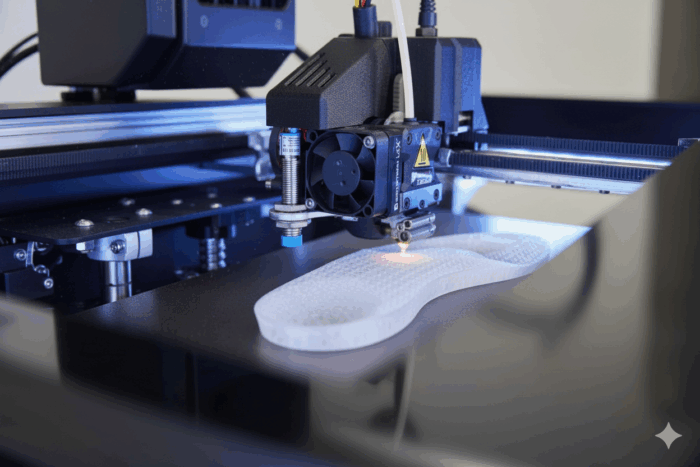
In the evolving world of foot health and rehabilitation, 3D-printed orthotic insoles are emerging as a promising frontier — offering personalized support and innovative design that traditional insoles can’t easily match. These custom devices are not just about comfort; they are designed to actively reshape the way the foot interacts with the ground, redistributing pressure, correcting alignment, and supporting long-term health.
Recent studies have shown strong evidence of their benefits. A systematic review (2023) reported that 3D-printed insoles improved plantar pressure distribution, reduced foot pain, and enhanced comfort for patients with flat-foot and diabetic foot conditions. Another clinical study (PubMed, 2020) observed that patients with leg-length discrepancy experienced significant reductions in lower-back and joint pain and improved gait balance after 12 weeks of using 3D-printed insoles. Similarly, a comparative study (2022) found that custom 3D-printed insoles provided superior comfort and redistributed metatarsal pressure more effectively than prefabricated ones in flat-foot patients.
In the materials domain, researchers from Springer (2025) investigated solid-liquid composite 3D-printed insoles under 100,000 gait cycles, revealing key insights into fatigue resistance and durability. Meanwhile, a study published in MDPI (2024) demonstrated how “auxetic” 3D-printed insoles, designed with thermoplastic polyurethane (TPU), improved mechanical flexibility and comfort in patients requiring targeted arch support.
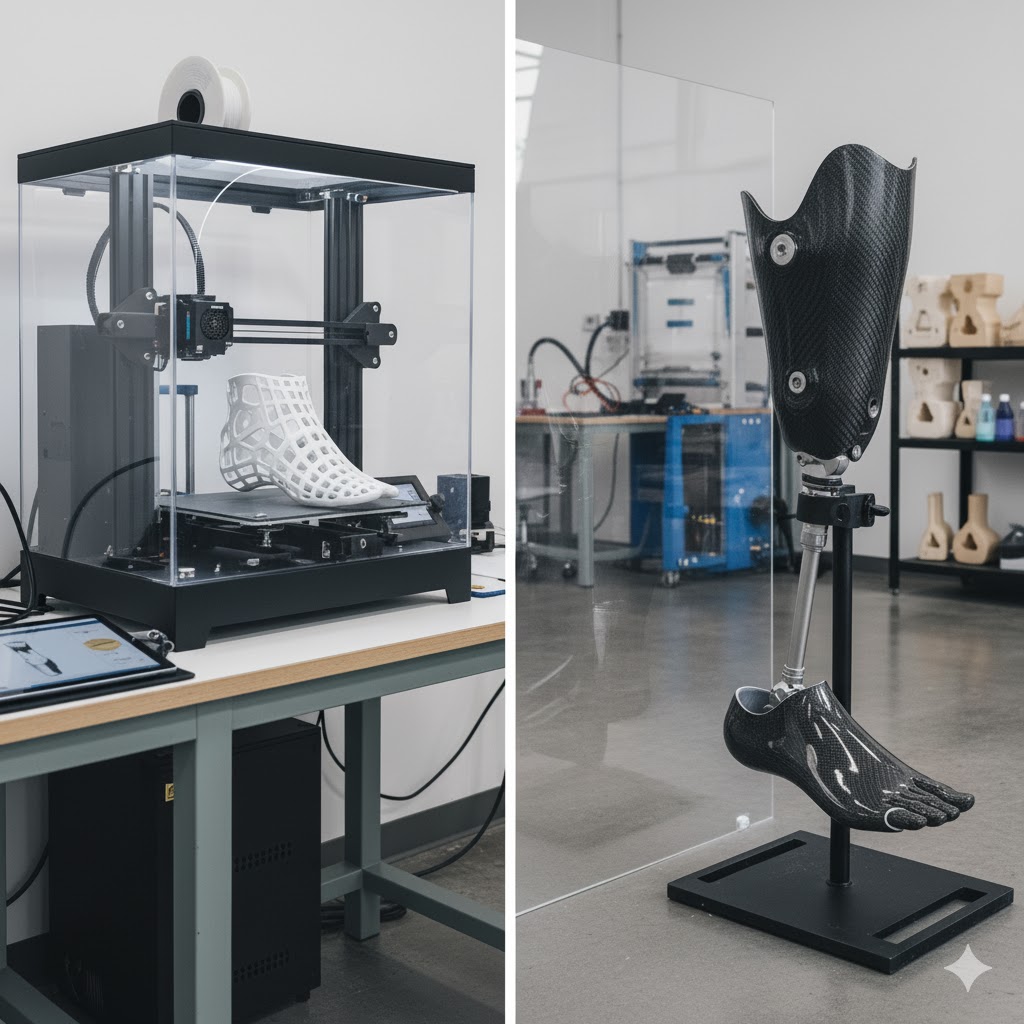
Beyond comfort and function, 3D-printed insoles promise a revolution in digital customization and sustainability. Using CAD/CAM workflows and baropodometric scanning, clinicians can design insoles precisely tailored to an individual’s anatomy and gait dynamics. Future models are expected to incorporate smart sensors that monitor gait and pressure in real time — potentially transforming diagnostics and rehabilitation outcomes.
While challenges remain — including standardization, long-term wear testing, and clinical regulation — experts agree that the technology’s potential is enormous. As 3D printing becomes faster, cheaper, and more data-driven, personalized insoles may soon become the clinical standard, bridging comfort, care, and cutting-edge science in one step.
References
- Comparative Study of the Effects of Customized 3D-Printed Insole and Prefabricated Insole on Plantar Pressure and Comfort in Patients with Symptomatic Flatfoot, KNWV (2022). https://www.knwv.be
- Effectiveness of 3D-Printed Insoles on Foot Pressure and Pain: A Systematic Review, CJRTP (2023). https://www.cjrtponline.com
- Clinical Evaluation of 3D-Printed Insoles for Leg-Length Discrepancy Patients, PubMed (2020). https://pubmed.ncbi.nlm.nih.gov/32444588
- Experimental Study on Solid–Liquid Composite 3D-Printed Insoles Under Repeated Gait Cycles, Springer (2025). https://link.springer.com/article/10.1007/s00170-025-16204-4
- Auxetic 3D-Printed Insoles for Flat-Foot Patients Using TPU Filament, MDPI (2024). https://www.mdpi.com/2411-9660/9/1/15
- Biomechanical Evaluation of 3D-Printed Insoles Using Different Materials and Infill Patterns, PubMed (2023). https://pubmed.ncbi.nlm.nih.gov/37423011
- 3D-Printed Orthotic Insoles and Their Clinical Outcomes: A Review of Current Evidence, BMC Musculoskeletal Disorders (2025). https://bmcmusculoskeletdisord.biomedcentral.com
- 3D-Printed Insoles in Clinical Practice: Challenges and Future Directions, PubMed (2025). https://pubmed.ncbi.nlm.nih.gov/40890671