Orthotics and Prosthetics as a Career: Understanding BS Programs in Pakistan

If you have ever seen someone walk confidently on a prosthetic leg, or wear a brace that corrects the way they stand, you have already seen the work of an orthotist prosthetist. It is one of those professions that quietly changes lives, one limb, one brace, one patient at a time. And if you are a student in Pakistan wondering whether this field is worth pursuing, this article is written for you.
Let’s start with the simple question every student asks first. What exactly do these professionals do? An orthotist designs and fits braces and supports for people who have weakness, deformity, or injury in a part of their body. A prosthetist does something similar, but for people who have lost a limb, by designing and fitting artificial arms or legs. In most training programs, both skills are taught together, so graduates usually become qualified in both areas, which is why the profession is often written as O&P, or orthotics and prosthetics.
Why does this field matter so much, especially in Pakistan? Think about how many people around you have needed a walking aid after an accident, or a limb after diabetes related complications, or support after a stroke. Road accidents, congenital conditions, diabetes, and war related injuries all create a steady need for skilled orthotists and prosthetists. Yet the number of trained professionals in the country is still limited compared to how many patients need them. That gap is exactly why this can be a meaningful and stable career choice.
Now you might be asking, is this course available as a proper university degree in Pakistan, or is it just a short technical course? It is a full four year Bachelor of Science degree, spread across eight semesters, and it is recognized under the Higher Education Commission’s general structure for such programs. So it sits alongside other medical and health science degrees, not as a side certificate but as a proper professional qualification.
Where can a student actually study this in Pakistan? A few names come up when you look into this field. The Pakistan Institute of Prosthetic and Orthotic Sciences, known as PIPOS, based in Hayatabad Peshawar, is one of the oldest and most established names here. It actually began decades ago as a training centre supported through cooperation between Pakistan and Germany, and over time it grew into a degree awarding institute affiliated with Khyber Medical University. Along with PIPOS, other institutes in Peshawar such as Mahboob Medical Institute and Hayat Abad based rehabilitation centres also offer this degree under the same university affiliation. Outside Peshawar, the University of Lahore offers a BS in Orthotics and Prosthetics Technology as well. RMU, KFUIT, UOL, and the Armed Forces Institute of Rehabilitation Medicine, connected with National University of Medical Sciences, is another option, especially known for its work with amputees and injured soldiers. So the good news is, this is not a program limited to just one city, though Peshawar remains the traditional home of this profession in Pakistan.
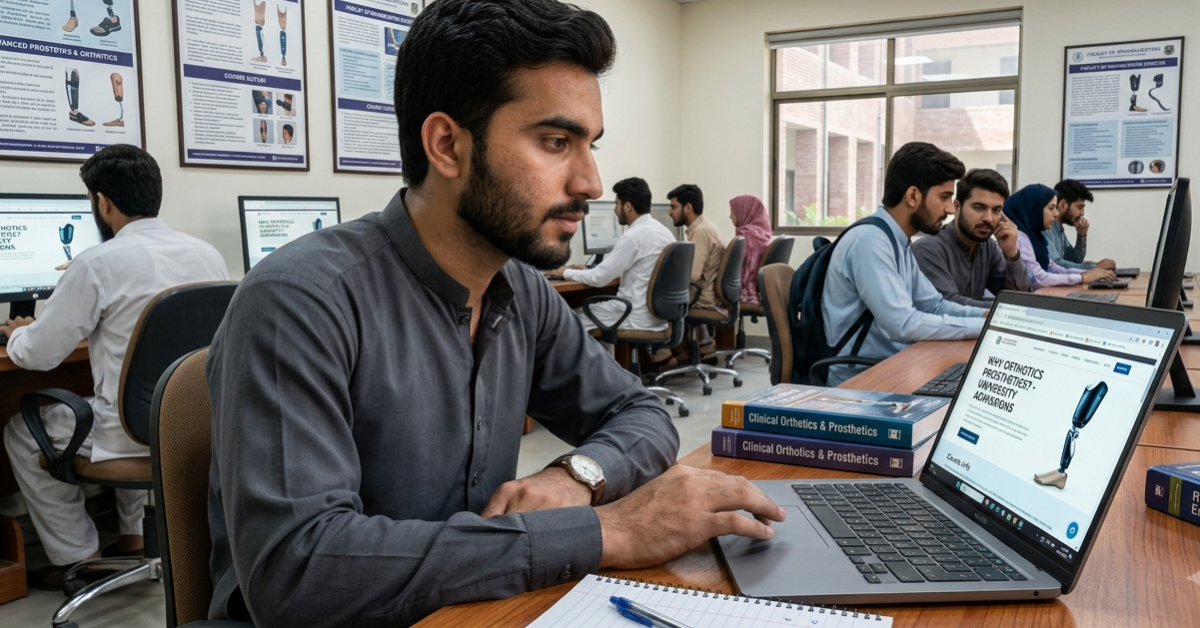
What will you actually study during these four years? The first two years usually build your foundation, subjects like anatomy, physiology, mechanics, basic engineering concepts, and general education subjects. As you move into the later semesters, the focus shifts toward the real craft, upper limb prosthetics, lower limb prosthetics, spinal orthotics, biomechanics, materials used in fabrication, and workshop based practical training. The final year is where things become real. You are placed in clinical settings, working directly with patients, learning to measure, cast, design, fabricate, and fit devices under supervision. This hands on clinical exposure is what shapes a student into an actual practitioner by graduation.
A common worry students have here is whether this is more of a technical trade or a proper medical profession. It genuinely sits at the meeting point of both. You need a solid understanding of human anatomy and physiology, similar to other health science students, but you also need practical skills, working with materials, using tools, understanding mechanics, almost like an engineer working with the human body. If you enjoy both science and working with your hands, this balance can feel very satisfying rather than confusing.
What about eligibility? Across the institutes offering this program, the general requirement is an FSc Pre Medical background, or an equivalent qualification, along with meeting the entry test and merit requirements set by the specific university or institute. Since admission criteria, required percentage, and entry test formats can differ slightly between institutes and can change from year to year, it is always worth checking directly with the institute you are interested in before applying.
Once you graduate, where does this degree actually take you? Within Pakistan, graduates typically work in hospitals, rehabilitation centres, government health institutions, and private clinics. Some join non government organizations that support people with disabilities or war affected regions. Over time, many professionals also move toward private practice, opening their own clinics once they have gained enough clinical experience. And here is something worth pausing on. This qualification is also recognized internationally. Around the world, organizations like the International Society for Prosthetics and Orthotics, generally referred to as ISPO, help set standards and recognition for this profession, which means graduates from accredited programs are not limited to working only within their home country.
Is this field only about medicine, or is there room for growth and specialization later? There absolutely is room to grow. After completing the BS degree, professionals can pursue further studies, specialize in areas like pediatric orthotics, sports related devices, or advanced prosthetic technology, or move into teaching and research roles within the same institutes that trained them. As the field grows in Pakistan, there will also be more room for professionals to shape training standards and policies for the profession itself.
If you are still deciding whether this path is right for you, ask yourself one honest question. Do you feel a pull toward helping people regain movement and independence, while also enjoying the technical, hands on side of building something that actually works for a real person’s body? If your answer leans toward yes, orthotics and prosthetics might be exactly the career worth exploring further.
Before applying anywhere, it is always a good idea to visit the official websites of the institutes mentioned here, or contact their admission offices directly, since fee structures, seat availability, and entry test details are updated by each institute and can change from one admission cycle to the next.
OPPAK is Pakistan's dedicated hub for orthotics and prosthetics since 2006— connecting students, professionals, patients and employers with credible news, education pathways, jobs, and success stories.
Leave a Reply